

Three minutes with Chris Cracknell, CEO, OCS
 By UK India Business Council (UKIBC)
Greater modernisation and a real willingness to embrace foreign investment will present an abundance of opportunities for British business, says Chris Cracknell, CEO, OCS.
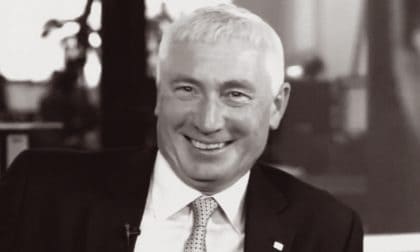
Chris Cracknell is Chief Executive of OCS Group, the facilities services company that operates across five continents, with over 91,000 employees. Founded over 100 years ago, sales exceeded £870m in the year to March 2014 – around a quarter of which came from operations in Asia Pacific. Chris joined OCS Group in 1977 after holding posts in the UK and overseas and was appointed to the Group Board in 1985. He was responsible for emerging companies and international development, including Thailand and New Zealand, which remain two of the largest and most significant international contributors to the Group’s results and profitability.
In April 2015, OCS Group received a Queen’s Award for Enterprise in International Trade.
How did a family window-cleaning business grow into a global phenomenon?
It’s still a family business today. When I took over as chief executive in 1996 I had a key ambition to increase our geographic coverage, and Asia in the emerging markets was a point of focus for me. We started off in Thailand in 1988/1989 with our first investments there, progressing from a very small business into our regional operating headquarters.
This led to expansion into New Zealand, Australia and into other Southeast Asian countries. We moved into India with our first janitorial contract in about 1999. In 2012, after a period of learning about the market, we made a series of three other investments to broaden our scope and capabilities within India.
Operating to global standards Greater modernisation and a real willingness to embrace foreign investment will present an abundance of opportunities for British business, says Chris Cracknell, CEO, OCS. We then grew our business in the Middle East and the culmination was the Queen’s Award for Enterprise for international trade this year.
How do you guarantee the level of organisation and quality that you need to when your providing such a huge array of services?
At one level you can look at it as a wide range of services, but at another level actually it’s very narrow. It’s about making a building operate to greatest effect for the client and our expertise is in coordinating the data, in coordinating the site management and sharing best practice from around the world. It’s not one glove fits all; it’s actually about tailoring a solution that’s quite specific to the needs of that client and the area in which they’re operating.
We have to take into consideration clients that operate in multiregional destinations with different languages and cultures, where the state of the economy can be completely different. This has an impact on how we can operate. You can’t just run it remotely from overseas – these are people that are carrying out duties and making decisions every day and every minute for the client on site. That’s where our expertise lies, around our computer-aided facilities management programmes, around the training we give our staff and how we bring that together as a package for the client.
Obviously commercial buildings, whether factories or hotels, is about the provision of all the services that enable those buildings to function. It requires us to manage the data of that building such as the movement of people in and out of a shopping centre or commercial office, taking decisions such as when you need the heating or the air conditioning and how that can be run in a sustainable economic way.
It’s about the provision of soft services, the catering, the cleaning, washroom hygiene, anything that enhances how that building operates. Most of our clients want to focus on their core activity; we want to provide them with an environment in which they can do that effectively and that is what we do in facilities management. We’re able to coordinate our expertise from around the world and share best practice in our solutions anywhere in the world. That’s one of the great positives with OCS.

So is it fundamentally about organisation?
We are a people-intensive business, employing, training, organising and leading. It is about giving them empowerment and delegated authority to act in the best interests of our clients. I go around the business on a regular basis and meet people on the front line, and I’m always amazed the extraordinary lengths they go to in ensuring our customers get quality service and a solution they need every day.
How did your business in India grow?
India is a fascinating market case for us. There’s a huge amount of potential within India as it emerges and moves forward, and yet it has a number of inherent challenges that we need to overcome.
Initially there’s a real need to understand the culture. So our first move was to find Indian business partners that we could trust who could provide the local knowledge to complement our international knowledge.
Our first janitorial contract gave us a platform to gain a greater working knowledge of the Indian economy. We then moved in and launched our washroom hygiene business, again by way of a joint venture, under the Canon brand. Having a local partner enabled us to understand some of the nuances of India and how it works, especially when employing a lot of people. So we needed that bridge. We chose people who share our ethics in our approach to business and the longevity of our goals. This enabled us in 2012 to make three further significant acquisitions to bolster our skills.
‘INDIA IS KEEN TO GET AHEAD – A LOT OF PEOPLE IN INDIA ARE LAPPING UP EDUCATION, BUSINESS OPPORTUNITY AND A DESIRE TO IMPROVE THEIR STANDARDS OF LIVING.’
Acquisitions here have provided a rapid growth performance for us, enabling us to jump to a higher platform straight away. We can complement that with training and organic growth, and that has worked extremely well for us.
India itself, as a marketplace, is not easy necessarily to understand but I think when you look at the growing middle class within India, it gives you some idea of the potential of the Indian economy for the long term. Is it going to be easy? No, of course it’s not, but actually by working and growing a local management team that lives and breathes the way India works, then we can develop a sustainable business into the future and that’s exactly what is happening for us now.
Mr Modi famously described the relationship between the UK and India as an unbeatable combination. Do you agree with that statement?
The statement has a lot of value. UK and India have a unique opportunity to work together incredibly well.
Clearly there’s a lot of history that sits behind that statement, but essentially we have the capabilities to export from the UK into the Indian market. We have a huge advantage in the English language being very well spoken throughout India, and with Mr Modi’s visit to the UK in the near future. There are further opportunities for British companies to build and cement their bonds with India and the new Indian government.
As an economy it is rapidly growing; it has a very large workforce, which is mobile and extremely keen to be educated and learn. They are all good ingredients for anyone wishing to invest. However, there will be challenges. There is a degree of protectionism; there are frustrations in operating in India and there are challenges around the way some of the cultural issues interface and contradict with business.
The way we have to operate now is to go in and understand those cultures, how the economics of the country work, and work within the structure and environment that India presents. If you’re prepared to do that and understand it and love the country, then the opportunities in front of you are enormous and the relationship between Great Britain and India will be a real positive for the future.
What’s your take on the future, for OCS in particular and for UK companies in India in general?
The big fundamental for me is the growing Indian middle class. A larger proportion of population in India can now travel overseas to see what the rest of the world is like, bringing back new ideas and ways of working.
India is keen to get ahead – a lot of people in India are lapping up education, business opportunity and a desire to improve their standards of living. This is a really good fundamental; the country has a lot of internal business so it’s self-sufficient in many ways. It can also operate on a global basis – look at the number of Indian businesses now operating around the world. I think if we ignore or underestimate the power of the Indian economy it will be our downfall.
In the next few years, I see greater modernisation and a real willingness to embrace foreign investment, but with restrictions. Those restrictions are not going to disappear quickly – we have to accept that and work with them. Through education hopefully those restrictions, whether it’s in percentage shareholding in say the security business, or whether it’s a restriction on how you can operate, will ease over time as the Indian economy is more established its own right.
WHAT NEXT?
Contact Steve Buckley, Asia Pacific Advisor,OCS on 07884 293 091 or
email steve.buckley@ocs-group.com


